From credential records to outcomes evidence

CredLens connects verified credential records to employment, earnings, and educational outcomes — so you can see what happens after someone earns a credential, and invest in what works.
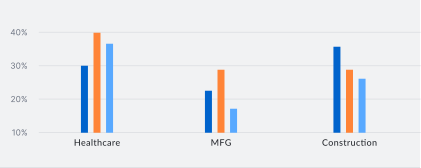
Employment by Industry Grouped bar chart comparing five industries across three measures. PORTFOLIO INSIGHTS Employment by Industry Compare earnings, employment, and education levels across programs. 100 75 50 25 Nursing Assistant Data Analytics Welding Tech Cybersecurity Business Admin
The CredLens Insights Platform

From credential data
to actionable insights.

The CredLens Insights Platform gives credential issuers a more complete picture of outcomes — from earnings trends and demographic segmentation to peer benchmarking and career pathway exploration. Reports are built for board presentations, funder requirements, and cross-organization data sharing.

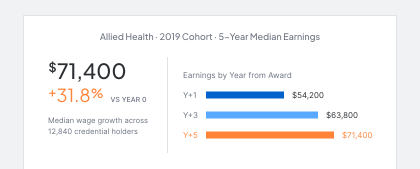
Earnings trajectory dashboard

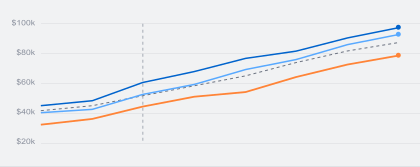
Track median wage growth at 1, 3, and 5 years post-credential, segmented by demographic and region.

Employment distribution by industry

See where credential holders work — broken down by industry sector and employer.

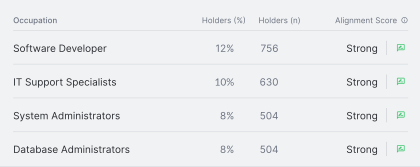
Job alignment scoring

Measure how closely graduates' roles align with the career paths your credential is designed to enable.

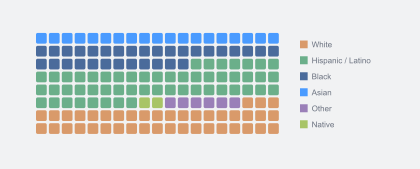
Demographic segmentation views

Disaggregate outcomes by gender, age, race/ethnicity, and prior education to surface disparities.

Reporting suite

Access role-based dashboards, generate reports for board presentations and grant applications, and export CSV/Excel files.

Career mobility

Track where credential holders go after their first role: industry transitions, wage progression, and upward movement over time.

Outcomes data sources exist,
but unlocking meaningful insights
‍doesn't have to be this hard.

surveys
Unreliable and incomplete
Low response rates and self-reported data leave critical gaps in your outcomes story.
research
Resource-intensive and hard to scale
Rigorous studies require dedicated staff, methodology expertise, and budgets few institutions have.
data sources
Siloed and hard to access
Wage records, employment data, and education outcomes live in different systems — none built to talk to each other.

Access more data sources.
Track outcomes at scale. Understand the context.

Access to data sources that were out of reach.

CredLens builds and manages data partnerships and infrastructure to connect you to quality outcomes data from multiple sources — through a single platform.

Outcomes data across your portfolio, at scale and on demand.

Track longitudinal outcomes across your full credential portfolio through one platform — available when you need them, not once every few years.

Benchmarks and counterfactual comparisons for your programs.

Contextualize your credential holder outcomes against comparable programs and populations who didn't earn the credential.

We turn raw data into the insights that help you
‍answer the questions that matter.

Earnings
Understanding what your credentials are worth — in real dollars for your learners — is the foundation of any conversation about credential value.
CredLens connects credential attainment records to high-quality data sources so you can understand the economic outcomes associated with earning your credential.
How do earnings change for credential holders over time, and how do outcomes vary across demographic groups?
How do earnings for your credential holders compare to those of similar individuals who did not earn the credential?
How do your credential holders' earnings stack up against those with similar credentials in the same field?
How do your credential holders’ earnings compare to cost-of-living benchmarks, such as the living wage, in the geographies where they live and work?
Employment
Earnings tell part of the story, but where your credential holders work, in what roles, and whether those roles align with what your credential targets tell you whether your credential is delivering.
CredLens surfaces the employment outcomes that help you understand your credential's real-world impact.
Where are your credential holders working: which employers, industries, and occupations?
How closely are your credential holders' jobs aligned to the occupations for which your credential is designed?
What career paths do credential holders take before and after earning your credential — and what does that reveal about who your learners are and where they're headed?
Which employers are hiring your credential holders, and where are the strongest opportunities for employer partnerships?
How do employment outcomes for your credential holders compare to those with similar credentials in the same field?
How exposed are the occupations your credential supports to AI-driven automation, and how is employer demand for those occupations trending?
Education
Credentials rarely exist in isolation — they're part of larger learning journeys that span multiple programs, institutions, and milestones.
CredLens helps you understand how your credential fits into those pathways, so you can strengthen the value you deliver and identify new opportunities to serve learners at every stage.
What other credentials do your credential holders earn before or after yours — and what stacking patterns emerge across your portfolio?
Which credentials are stacking with yours, and what does that tell you about how learners are using your credential in their careers?
How do credential stacking patterns compare across your portfolio — and which pathways are producing the strongest outcomes?

How it works

Go from your credential records to actionable outcomes insights in just a few weeks. CredLens manages the full journey — from secure data intake through matching, validation, and delivery — so your team spends time on the insights, while we handle the infrastructure.
01

You share your credential records

Provide verified records of credential holders through a secure data pipeline
02

We match to outcomes

Records are securely matched to quality outcomes data across earnings, employment, and education
03

We verify and integrate

Records are validated against quality thresholds and suppressed where coverage is insufficient
04

You see the outcomes

Access interactive dashboards showing earnings, employment, and demographic insights

From conversation to insights in weeks, not months.

A typical CredLens engagement moves from kickoff to actionable outcome data in under 60 days. But getting there starts with the right data foundation.

Does CredLens work with your data?

CredLens works by matching your credential holder records to vetted third party data sources. The richer your records, the stronger your match rates — and the more meaningful your insights.

The organizations that get the most out of CredLens typically share a few things in common.

Credential volume and history

You're issuing credentials at scale — generally 100 or more credential earners per credential per year — and your records go back at least two years. Longitudinal insights require longitudinal data.

Holder information

You collect consistent personal information on your credential holders. These fields are what make it possible to match your records to outcomes data. The more consistently they're collected, the stronger your results.

Sound like you?

Frequently asked questions

What can I see in the CredLens Insights Platform?
The CredLens Insights Platform provides longitudinal outcomes for the people who earned your credentials, including employment, earnings, employers, occupations, and job alignment, depending on available source coverage. You can examine results by credential, cohort, year, and selected demographic groups, compare outcomes across your own portfolio, and export results for reporting and other uses.
What types of credentials does CredLens support?
CredLens works with certificates, certifications, degrees, workforce credentials, and other short-term training programs. The platform is built to support outcomes analysis across degree and non-degree credentials.
Learn more about who CredLens serves →
Is there a minimum number of credential earners needed?
Yes. Each credential should have a minimum of 100 earners per year in order to provide you with meaningful, reliable insights.
How does CredLens connect credential records to outcomes?
CredLens matches the credential records you share with multiple high-quality data sources, then shares the resulting outcomes data through the CredLens Insights Platform. The process moves through data intake, matching, validation, and delivery, with transparency into source coverage, methodology, and match rates.
‍See how CredLens turns records into outcomes insights →
What data sources does CredLens use?
CredLens draws from multiple high-quality employment, earnings, and education data sources to build a fuller picture of what happens after a credential is earned. Using multiple sources helps provide broader coverage and allows outcomes to be refreshed over time.
What data do we need to provide?
For matching, CredLens uses credential-holder information including name, date of birth, address, email, and phone number. Social Security number is optional but can improve match rates. To enable deeper analysis, organizations can also provide demographic attributes such as gender, race/ethnicity, and age, along with other attributes relevant to their reporting and analysis needs.
What match rate can we expect?
Match rates vary based on the population being analyzed, available source coverage, and the completeness of the credential-holder records provided. CredLens provides transparency into match rates and source coverage so you can understand the data behind the outcomes you are seeing.
How long does implementation take?
From data submission to initial dashboards is typically within two months, depending on data readiness, data-sharing agreement and security review, and record completeness. Once dashboards are live, you have ongoing access, and results can be refreshed as new data cycles are processed.
How does CredLens protect our data and credential-holder privacy?
CredLens is purpose-built to steward sensitive data under clear rules about how data is contributed, accessed, and used. Our security and privacy infrastructure is certified to ISO/IEC 27001:2022 and ISO/IEC 27018:2019 standards, with SOC 2 Type II, SOC 3, and TX-RAMP compliance. We only return aggregated outcomes and suppress results for groups that are too small to protect individual privacy.
Learn more about our privacy and security commitments →